
What to Do When You Have No Money: 15 Steps to Survive

There is a specific moment. You check your account. The number is zero, or close enough that it does not matter. The kitchen is bare. The bills are real. And you are sitting there trying to figure out what to do when you have no money with no clear idea of where to start.
I have seen people come back from this. People who had nothing not a cushion, not a backup plan, not a safety net and rebuilt completely. What you do in the next 24 hours is not everything, but it is the part that sets the direction. This guide covers that, start to finish, in the order that actually works.
Stop. Take a Breath. Here’s What Having No Money Actually Means
Most financial advice starts in the wrong place. It assumes you have a money problem. You do not.
Not having money and having a money problem are two completely different situations. A money problem is what someone faces when their investments are underperforming or their business has a cash flow crisis. What you are dealing with right now is survival mode and survival mode is simpler and more manageable than an actual money problem, because the path out of it is concrete and immediate.
Ankur Warikoo now a well-known entrepreneur and author was 29, jobless, newly married, and had nothing in the bank. He talks about that period openly. His actual advice from it: stop counting the years behind you and start counting the ones ahead. That shift in direction is where recovery begins.
You Are Not Failing : You Are in a Temporary Crisis
Nearly everyone who has built real financial stability went through at least one period of genuine rock bottom. A recession that wiped out savings in a week. A medical emergency that drained everything. A relationship that ended and left one person holding zero. People have walked out of dangerous situations with only what they were wearing and rebuilt from there.
You are not the exception. The goal right now is not to feel better about the situation. The goal is to move. Just to take the next right step and nothing else.
What to Do When You Have Absolutely No Money (Zero Dollars)
When the number in your account is genuinely zero no cash, no card with a balance, nothing to work with the approach is different from having some money left. You are not budgeting. You are triaging. Triage means identifying what threatens you most first, then dealing with each thing in order. That is the framework this entire article follows.
Your First 24 Hours: A Financial Emergency Triage Plan
The biggest mistake I see people make at financial rock bottom is trying to fix everything at once. The panic kicks in and they either freeze completely or start making fast decisions that dig the hole deeper. Both responses make the first 24 hours worse than they need to be.
In medicine, triage means you address the most life-threatening problem first, then move to the next. You do not treat a sprained ankle while someone is bleeding out. Financial crisis works the same way and most people skip this step because nobody told them what order to follow.
Here is that order.
The One Financial Priority Rule Nobody Explains Clearly
Housing is the non-negotiable first line. Not credit cards. Not student loans. Not your phone bill. Housing.
This sounds obvious until you are sitting with a pile of bills and three missed calls from creditors. The reason housing wins every time comes down to one practical reality: food banks exist in almost every community, nonprofit organizations can step in for utilities, and credit card companies have hardship programs with legal timelines that give you actual breathing room before anything serious happens.
Lose your housing and every other problem multiplies. You lose your mailing address, which means you cannot receive assistance applications, benefit approvals, or job correspondence. You lose access to a kitchen, a stable place to sleep, and the fixed address that most government assistance programs require just to submit an application. Covering your basic needs starts with keeping that roof in place.
If you are behind on rent, call your landlord before they call you. Behind on a mortgage, contact your servicer today. Facing eviction, find a local tenant assistance program or legal aid organization right now many operate for free.
What to Stop Spending Money on Right Now
Before you figure out how to get more money in, stop every non-essential dollar going out. Today.
Go through your bank statements and your phone. Cancel or pause everything that is not food, housing, water, or power. Streaming services, gym memberships, premium app plans, any recurring charge you signed up for and forgot gone, or paused. If you need a complete breakdown of where to find hidden costs and how to systematically eliminate them, this guide on reducing your monthly expenses covers the full process. Most subscription companies will grant a hardship pause if you call and ask. It takes five minutes and saves you money this week.
Switch your phone to a prepaid or budget carrier temporarily. If you have been eating out at all, stop completely. Home cooking with the most affordable staples you can find is the only option right now.
These cuts do not fix the crisis. But they slow the drain while you work on the income side.
What to Do When You Have No Food or Money
Food is the second priority after housing. And there are more free food resources available right now than most people in financial hardship ever find out about. That gap between what exists and what people actually access is one of the most frustrating parts of this situation so this section covers every practical option I know.
How to Find a Food Bank in Your Area Today
The Feeding America network operates food banks across every US state. Visit feedingamerica.org, type in your zip code, and your nearest location comes up within minutes. Most food banks ask no questions, require no proof of income, and in many cases do not require ID.
If you do not have internet access, dial 211. It is a free national helpline that connects you to local resources including food pantries I cover what 211 can do for you in detail later in this article.
Other places to find emergency food today:
- Local churches and religious organizations almost always have food programs or pantries, open to anyone regardless of affiliation
- Community Facebook groups search your city name plus “free food” or “food assistance” and you will often find neighbours actively sharing resources
- Local charities including the Salvation Army and Catholic Charities both operate food assistance in communities across the country
- School districts often run summer meal programs for children that families can access
These food assistance programs exist specifically for moments like this one. Most of them ask no questions. You walk in, you get food.
One practical note from someone who has been in this situation: spend what little cash you do have on foods with high calorie density and long shelf life. Peanut butter, dried beans, rice, oats, and canned vegetables stretch money much further than anything prepared or convenient.
Apply for SNAP Benefits Even If You Think You Will Not Qualify
The Supplemental Nutrition Assistance Program (SNAP) provides monthly food benefits to low-income individuals and families. A lot of eligible people never apply because they assume their income is too high or the process is too complicated. Both assumptions are usually wrong.
If you have no income right now, you very likely qualify. In many states, people with zero income can receive expedited SNAP benefits within seven days of applying.
Apply online at benefits.gov, through your state’s social services website, or in person at a local SNAP office. The application covers household size, income, and basic expenses. It takes around 30 minutes.
Do not let the paperwork stop you. Depending on your household size, SNAP benefits can cover several hundred dollars per month in food costs. That is money you no longer have to spend — which means whatever cash you do earn goes toward rent, utilities, and everything else.
How to Get Money Right Now With Nothing in Your Pocket
No starting capital. No time to waste. Every method in this section comes from real people who used it during a genuine financial crisis not theory, not a list someone compiled from other lists. Things that worked.
Sell What You Own (Fastest Path to Same-Day Cash)
Declutter and sell everything in your home with remaining usefulness. Electronics, clothing, furniture, kitchen appliances, sports equipment, books, tools almost anything can be sold within hours on the right platform.
Facebook Marketplace is usually the fastest option because buyers are local and deals can close the same day with cash in hand. eBay works well for electronics and collectibles but takes longer due to shipping time. Craigslist handles larger items like furniture reasonably well. Pawn shops give you same-day cash but typically pay 30 to 50 percent of actual value, so treat them as a genuine last resort.
Price to sell, not to get maximum value. A $40 item that closes today is worth more right now than an $80 listing that sits for three weeks.
One approach worth knowing: drive through alleys in your neighborhood and look for discarded metal and furniture. Items other people have thrown out can often be sold on Facebook Marketplace or taken to a metal recycling center for cash. It costs nothing to start.
Some people have used this as their primary income source long enough to cover three months of rent. If you need additional strategies beyond selling items, this guide covers other ways to make money quickly when you’re starting from zero.
Same-Day Gig Work That Pays Within Hours
Several gig economy jobs allow you to start earning within 24 to 48 hours of signing up.
DoorDash, Instacart, and Uber Eats all run background checks that typically complete within one to three days. Once approved, you start taking deliveries immediately and can cash out the same day through their instant pay features. You need a smartphone and a working vehicle, though some Instacart routes can be completed without a car.
TaskRabbit connects people who need help with moving, furniture assembly, cleaning, and handyman work with workers who do those tasks. You set your own rate and get paid through the platform.
No vehicle for deliveries? Post in your local Facebook community group offering yard work, cleaning, moving help, or other labor. One person I came across covered their rent gap by spending two months going door to door in their neighborhood offering leaf raking, basement cleaning, and carpet shampooing. They never asked anyone for help. They sold their time.
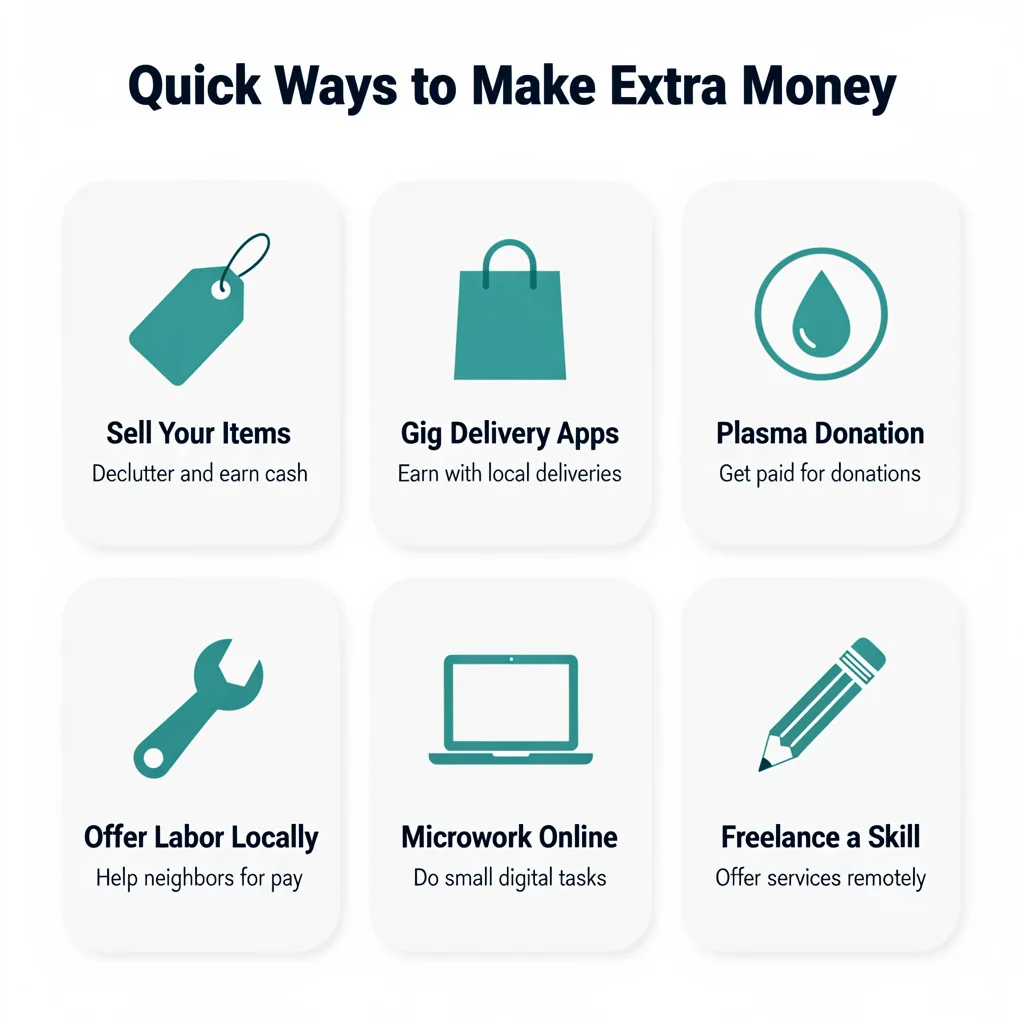
Quick Ways to Make Money Most People Have Not Tried
Plasma donation is the most consistently overlooked emergency income source I have ever come across. Most mid-sized and larger cities have plasma donation centers. Donors typically earn $50 to over $100 per session though compensation varies by center and location, so check your specific center for current rates before counting on a specific number. You can donate twice per week, and the first session usually includes a new-donor bonus. You need a government-issued ID and to meet basic health requirements. Search “plasma donation near me” to find a center.
Other income generation options that require zero startup money:
- Online focus groups and paid market research surveys pay $50 to $200 per session for your opinions on products and services. Respondent and UserTesting both connect participants with researchers
- Microwork platforms like Amazon Mechanical Turk or Clickworker pay for completing simple online tasks — data entry, image tagging, survey completion. The hourly rate is low but it requires only a computer and internet
- If you have a skill — writing, basic graphic design, data entry, customer service — Fiverr and Upwork let you start offering services with no upfront cost at all
I Need Money and Help : Programs That Can Actually Do Something
The gap between what help exists and what people in crisis actually find is enormous. There is a financial safety net of assistance programs in the US designed specifically for this situation and most people in financial hardship either do not know they exist or talk themselves out of applying before they even try.
Dial 211 The Emergency Lifeline Most People Do Not Know Exists
211 is probably the most underused number in America.
Dialing it on any phone connects you to a central hub that routes you to community assistance programs in your specific area. Operators can connect you with housing help, food programs, utility bills, mental health services, crisis intervention support, clothing, childcare, and more. It is free. Confidential in most areas. And available throughout most of the United States.
If you are in the US and you do not know where to start, this is the number to dial before you do anything else.
Government Benefits You Can Apply for Right Now
Several federal and state programs exist specifically for people with little or no income:
SNAP (Supplemental Nutrition Assistance Program): Covered in detail above. Apply at benefits.gov or your state’s social services portal.
Unemployment Benefits: If you recently lost a job through no fault of your own, you may qualify for state unemployment assistance. Apply through your state’s labor department website. Approval typically takes one to three weeks and benefits can be retroactive to your application date.
TANF (Temporary Assistance for Needy Families): Provides short-term cash assistance to families with children. Requirements and benefit amounts vary by state. Apply through your local social services office or state website.
LIHEAP (Low Income Home Energy Assistance Program): A federal program that helps low-income households cover heating and cooling bills. Contact your local community action agency or dial 211 to apply.
Medicaid: If you have no income or very low income and no health insurance, you very likely qualify. Apply at healthcare.gov or your state’s Medicaid office. Untreated health problems get more expensive the longer they wait this program exists to stop that from happening to you.
Nonprofit and Charity Emergency Assistance
Charitable organizations and nonprofit groups fill the gaps that government programs leave. Many offer one-time emergency assistance with rent, utilities, food, clothing, and transportation.
The Salvation Army provides emergency assistance including food boxes, utility help, and in some locations, limited rent and mortgage assistance. Find your local chapter at salvationarmyusa.org.
Catholic Charities operates through local chapters across the United States and provides temporary financial help regardless of religious affiliation. Services vary by location but often include emergency financial assistance, food pantries, and case management.
Local community action agencies often called CAAs receive federal funding specifically to help low-income individuals and families. They often connect you with multiple forms of help in a single visit.
Do not feel embarrassed to call a local church, mosque, synagogue, or temple and explain your situation honestly. In my experience, congregations of every faith maintain discretionary funds for exactly this and most of them are quietly waiting for someone to ask.
How to Talk to Your Landlord and Creditors When You Cannot Pay
The calls nobody wants to make the landlord, the utility company, the credit card issuer are usually the ones that matter most. Most people wait until they have been avoiding them for weeks. By that point the negotiation is harder, not easier.
I want to walk you through what to actually say, because most of the fear around these calls disappears once you know what you are doing.
What to Say to Your Landlord Before You Miss Rent
Call before the due date, not after. Landlords are significantly more willing to work with a tenant who picks up the phone proactively than one who goes silent and misses payments without warning.
When you call, be honest and specific. Explain what changed job loss, a medical situation, an unexpected expense and give a realistic timeline for when you can pay. Ask directly whether a short extension or a payment plan is possible.
Most landlords are not looking to evict you. Eviction costs them money court fees, lost rent during the process, turnover costs, and the uncertainty of finding someone new. A tenant who picks up the phone and explains the situation is infinitely easier to deal with than one who disappears.
If your landlord agrees to a plan, get it in writing. Even an email confirmation protects both of you.
If your landlord is not flexible, look into local tenant rights organizations and legal aid. Many cities and counties have dedicated rent payment help and emergency rental assistance programs funded through state housing agencies. Dial 211 to find what is available in your area.
How to Pause or Reduce Your Utility and Credit Card Bills
Almost every major utility company electric, gas, water has a bill payment assistance program built into their hardship offerings. These programs can reduce your bill, create a payment plan, or pause disconnection. You have to call and ask for it by name. Search your provider’s website for “hardship program” or “payment assistance” or call their customer service line directly.
LIHEAP, mentioned earlier, can provide direct assistance with utility costs for qualifying households.
For credit cards, most major issuers have hardship programs that can temporarily reduce your interest rate, lower your minimum payment, or pause your payment for one to three months. These programs are not advertised credit card companies do not benefit from offering them but they exist and you have the right to ask for them. If you’re trying to assess your overall debt situation and whether it’s reached crisis levels, this guide on understanding how much credit card debt is too much can help you see where you stand.
When you call, say this clearly: “I am experiencing financial hardship and I would like to know what hardship options are available on my account.” Write down the name of the person you spoke with and what they agreed to.
Credit card payments never come before rent. That rule holds throughout this entire crisis.
Budgeting With No Income at All : Your Bare-Bones Financial Plan
When you start bringing in a little cash from gig economy jobs, from selling items, from whatever is working you need to know exactly where it goes. Not budgeting in the traditional sense. This is a budget emergency priority stack: every dollar has one job, and you assign it in a specific order. If you’re working with very limited income and need a complete framework for managing every dollar, this comprehensive guide on budgeting on a low income walks through the full system.
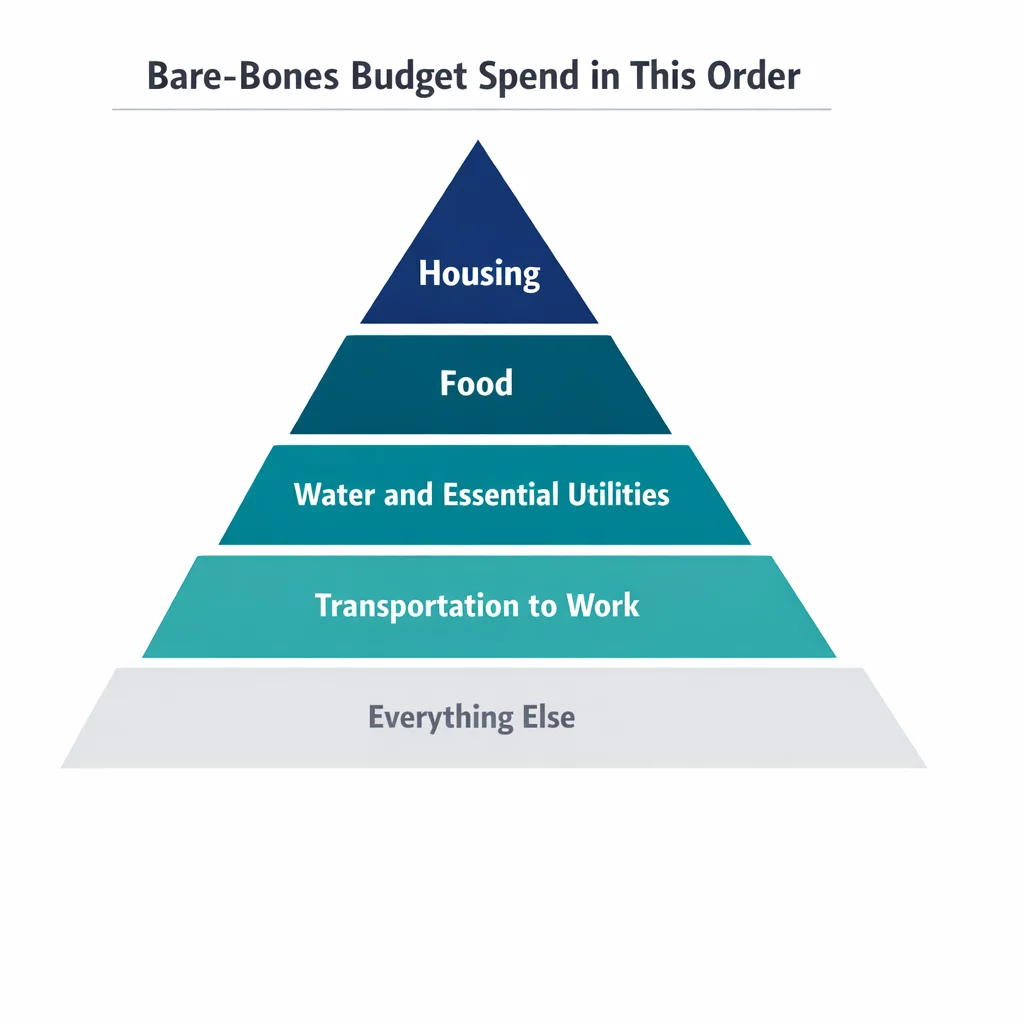
The Exact Order to Spend What Little Money You Have
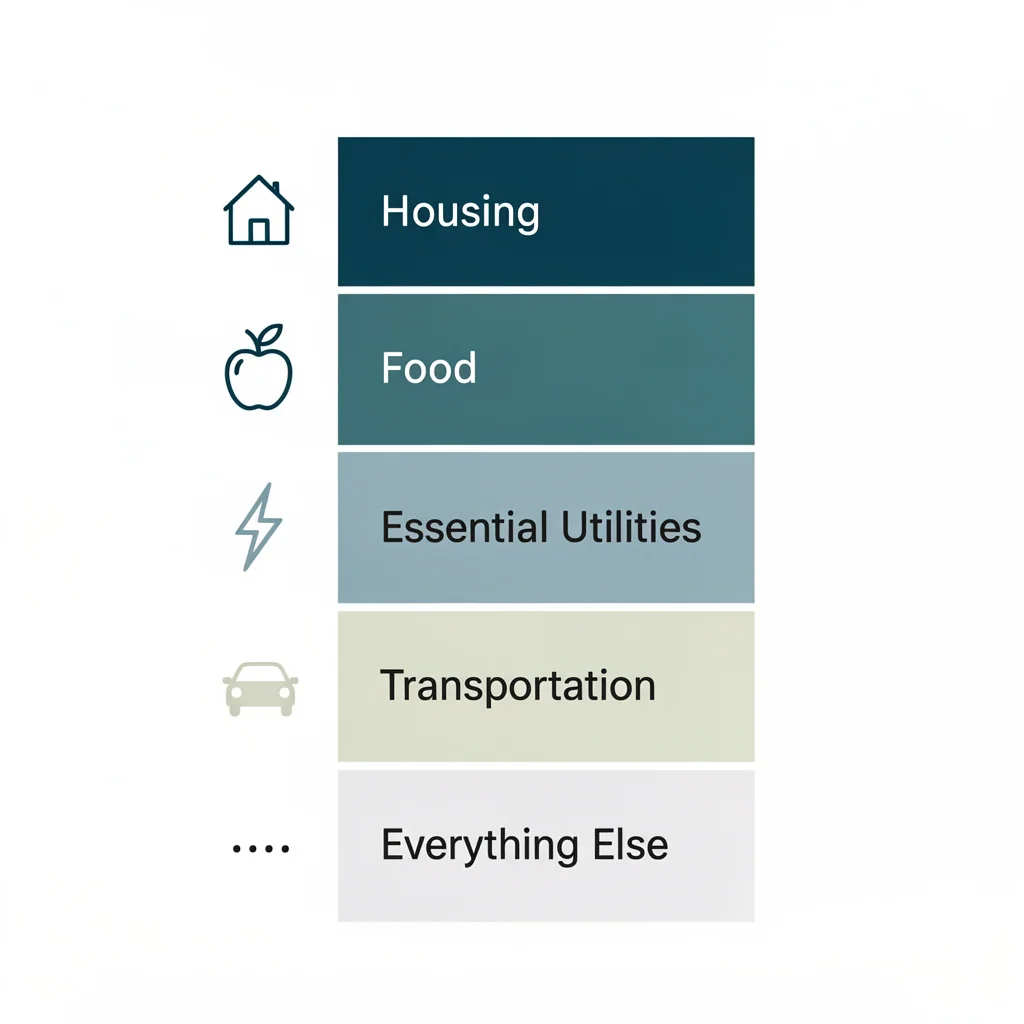
Here is the priority stack. Follow it in order and do not deviate until the higher priorities are covered:
- Housing (rent, mortgage, or contribution to wherever you are staying)
- Food (basic groceries, not restaurants)
- Water and essential utilities (power for heat or cooling, water if metered)
- Transportation that gets you to work or to income-generating activities
- Everything else
Credit cards, subscriptions, social obligations all of that comes after these five. Creditors will tell you otherwise. They are not wrong that you owe the money. But you cannot pay anyone if you lose your housing or stop eating. Math wins.
What to Do About Debt When You Literally Have No Money
You cannot pay debt you do not have. That is a fact, not an excuse.
When emergency expenses pile up and collectors start calling, know your rights. Under the Fair Debt Collection Practices Act, you can send a cease-and-desist letter in writing requesting all contact stop. Send it via certified mail and keep a copy. After receiving it, a collector can legally contact you once more to confirm receipt or notify you of a specific action — and that is it.
Payday loans, cash advances, and high-fee hardship loans are a trap. The fees and interest rates are engineered to create a cycle that is genuinely difficult to break. Avoid them unless you have a specific, documented plan to repay within the same pay period.
Nonprofit credit counseling agencies offer free guidance on managing debt. The National Foundation for Credit Counseling (NFCC) can connect you with free or low-cost counseling and help you understand what debt relief options are actually available to you. They can also help negotiate debt management plans with creditors on your behalf. Once you’ve stabilized your immediate situation and have some income coming in, these strategies for paying off debt quickly can help you eliminate what you owe and move toward full financial recovery.
Mistakes That Make a Financial Crisis Worse : Stop These First
Desperation narrows your thinking. You see something that looks like relief and you reach for it even when that thing makes everything worse six weeks from now. I have watched this pattern repeat in the stories of people who ended up deeper in crisis than when they started.
Borrowing money from family or friends without a written plan. It damages the relationship and usually does not solve the problem. If you do borrow, document it even a text message laying out the amount and repayment expectation protects everyone involved.
Paying a credit card before rent. I cannot say this enough. Collectors will make it sound urgent. It is not more urgent than your roof.
Taking predatory loans. Payday loans, title loans, high-fee cash advance apps they all look like a bridge and most of the time they are a pit. The crisis gets longer, not shorter.
Ignoring creditors entirely. Going quiet never helps. Creditors do not forget they escalate. A five-minute honest conversation often buys more time than two months of avoidance.
Refusing to change anything. The people who came back from genuine financial rock bottom shared one trait: they stayed open. They watched things, asked questions, admitted what they did not know about money, and adjusted. If you have been living paycheck to paycheck for years and you now find yourself with nothing, something in the pattern needs to change. Part of that often involves stopping overspending patterns that have been running on autopilot. Acknowledging that is not weakness. That is actually where recovery starts.
Things to Do When You Have No Money (That Actually Help)
Time is the one resource a financial crisis cannot take from you. What you do with it during this period matters more than most people realize not in a vague inspirational sense, but in a practical income-and-recovery sense.
Free Ways to Build Skills That Can Earn You Money Later
Free education is everywhere. YouTube has tutorials on virtually every skill that translates to income: writing, graphic design, video editing, coding, bookkeeping, social media management, and more. All of it free.
Google offers free career certificates in data analytics, project management, UX design, and IT support. Employers recognize them and they can meaningfully improve your job market position.
Your local public library has free access to computers, internet, and often online learning platforms like LinkedIn Learning. A library card costs nothing.
Focus your learning on skills that connect directly to the income methods covered earlier — gig work, freelancing, content creation. That way, every hour you spend studying has a direct path to a dollar.
Why Exercise and Movement Are Survival Tools Right Now
This is not generic advice about staying positive. Exercise has documented clinical effects on stress response. It reduces cortisol, improves sleep quality, and enhances the kind of cognitive function you need most when you are trying to solve hard problems without resources.
And it costs nothing. Walking, running, bodyweight exercises at home, free outdoor workout equipment in public parks physical movement is accessible regardless of income.
One story worth sharing: a person who went through a period of having no money started playing sports and working out consistently. They became skilled enough at their sport that they started earning money giving lessons and running group workouts. The activity that started as a mental health support tool turned into a side hustle. I have seen stranger pivots come from worse starting points.
The Mental Weight of Being Broke (This Part Is Real Too)

Financial struggle does not just affect your bank account. It creates a specific kind of psychological weight shame, anxiety, difficulty concentrating, and decision fatigue. Researchers Sendhil Mullainathan and Eldar Shafir documented this directly: financial scarcity consumes cognitive bandwidth, which means money stress physically impairs the thinking and decision-making you need most when you are trying to get out of it.
Most financial advice skips this entirely. So let me say it plainly.
If you are feeling hopeless, ashamed, or paralyzed right now, those feelings are a normal response to an abnormal amount of pressure. They do not mean you are broken. They do not mean recovery is out of reach.
Ankur Warikoo described being jobless and broke at 29 uncertain about his future, uncertain about his ability to provide for his newly married wife one of the hardest periods of his life. He rebuilt. Completely. His advice from that period is simply this: focus on the years you still have ahead, not the ones already behind.
Divya Murugesan, who wrote about going through a similar experience, put it simply: everyone faces these moments at least once. It is hard to stay positive in the middle of it. But coming through it is possible and it does not require anything except refusing to stop.
If the mental and emotional weight of this is becoming overwhelming, crisis intervention resources are available through 211 alongside the financial ones. Many communities also offer free or sliding-scale counseling. You do not have to carry this alone and working on the psychological side of this is not separate from solving the financial side. The two are connected.
Your Full Survival Plan: What to Do When You Have No Money
HEADING SUGGESTION: “Your Full Survival Plan: What to Do When You Have No Money” (replaces original “You Can Move Through This” for SEO signal optional)
Here is the full framework in one place.
Your first 24 hours: secure housing and cut the unnecessary spending. After that: find food through food banks, SNAP, 211, and local organizations. Then: generate emergency cash by selling items, doing gig work, donating plasma, or offering your time as labor. Access assistance programs through 211, government benefits, and nonprofits. Talk proactively to your landlord and creditors before they come to you. Build a bare-bones budget emergency priority stack and follow it. Use whatever free time you have to build skills and protect your physical and mental health.
That is the path. None of it is fast or comfortable. But every single step on that list has been taken by someone who started from a worse position than you are in right now. For additional practical tactics on managing on a tight budget once you’ve covered the basics, that guide offers strategies that work when money is extremely limited.
When you have no money and you are trying to figure out what to do, this framework is your starting point. Focus on the next step. Just that one.
Frequently Asked Questions
What is the very first thing I should do when I have no money?
Assess your two most urgent needs: food and housing. Cut all non-essential spending immediately. Then dial 211 to connect with local resources. Do not try to solve everything at once. Focus on the next 24 hours first, not the next 24 months.
Should I pay my rent or my credit card bill when I can only afford one?
Always pay rent first. Credit card companies have hardship programs, and collections timelines for unsecured debt give you meaningful breathing room. Losing your housing makes every other financial problem dramatically harder to escape. Unsecured debt is the lowest priority in a survival situation.
How do I get emergency food today if I have no money at all?
Call 211 to find the nearest food bank or food pantry. Visit feedingamerica.org and enter your zip code. Most food banks serve anyone without ID requirements or proof of income. Local churches and community Facebook groups are also reliable same-day sources for emergency food.
What is the 211 helpline and what can it actually help me with?
211 is a free national helpline available in most of the United States. Dialing it connects you to local operators who can refer you to community assistance programs for food, housing assistance, utility bill help, mental health services, crisis counseling, and more. It is free, available from any phone, and one of the fastest ways to find local help.
Can I really make money with no starting cash at all?
Yes. Plasma donation typically pays $50 to $100 or more per session and requires no investment. Facebook Marketplace sales of items you already own can generate same-day cash. DoorDash and similar gig economy jobs can be set up within 24 to 48 hours and offer same-day payouts. Offering yard work or cleaning through local Facebook groups requires nothing but your time. Once you have even a small amount of income coming in consistently, these strategies for saving money even on a very low income help you build a buffer so you never end up back at zero.
What do I do when I have no food or money and cannot leave the house?
Call 211 and ask specifically about food delivery assistance or home delivery programs. Apply for SNAP benefits online at benefits.gov. Contact the Salvation Army to ask about emergency food delivery in your area. Post in local community Facebook groups many neighborhoods have active mutual aid networks and will respond quickly.
Is it too late to turn things around if I am in my 30s with nothing?
No. Ankur Warikoo now a successful entrepreneur, author, and public figure was broke, jobless, and newly married at 29. His perspective from that period: focus on the years ahead of you. Financial recovery happens at every age. The decisions you make starting today are the ones that determine next year not the ones from five years ago.
What should I do about debt collectors when I have no money to pay?
You cannot pay what you do not have. Prioritize survival first — housing, food, and utilities before any unsecured debt. Contact a nonprofit credit counseling agency affiliated with the National Foundation for Credit Counseling for free guidance. Debt collectors have legal timelines and constraints under the Fair Debt Collection Practices Act. Your basic needs come before unsecured debt every single time.