How to Budget Groceries: A Step-by-Step System that works

It was the 24th of the month and I had $11 left in my grocery budget. The refrigerator contained three eggs, half a block of cheese and an ominous looking bag of spinach.
I had made a list. I had not gone to the snack section. I believed that I was doing it all right. It was never the tips that were the problem. The difficulty was that I did not really have a system which held those tips together.
I spent two years following every grocery receipt, trying budgeting software between YNAB and the cash envelope and a simple spreadsheet and talking with families that had figured out how to cut their food bills significantly. The next thing is the working system.
This is not a tips guide. It is an operating system of how to budget groceries that holds up week after week, through the busy weeks and unforeseen costs and months when prices are skyrocketing.
At the end, you will have a real number to work with, a weekly plan that prevents overspending at the beginning of the month, and an approach to shopping that will keep the budget intact without reducing every trip to the grocery to a stress test.
Why The Majority of Grocery Budgets Collapse Before the End of the Month
The majority of grocery budgets fail not due to poor decisions in the store. It does down before the shopper even leaves the house, because even the budget itself has been structured in such a manner that it virtually ensures that by the end of week three the budget has been exceeded.
They put a monthly limit on it, say $500, place all that money in a single mental bucket, which is the groceries. The initial week is a breeze. Here a nice coffee, there a specialty sauce. By the third week the cash has been almost exhausted.
Week four is either a case of over the budget or just eating whatever remained in the back of the pantry. For many households, the grocery problem is also a symptom of a wider pattern and learning how to reduce monthly expenses across categories is often what finally makes the numbers work. Things are even worse once the comparison trap is mentioned.
Many individuals will observe what other people are spending on their groceries and attempt to match/outdo them. But comparing your food spending with the situation of another person when you don’t know how many people live in their house is like comparing your electric bill with the position of another person without knowing the number of people that are living in that house.
Your real number is determined by your household income, the size of your family, where you live and what you eat all contribute to your real number in a way that no external comparison can explain. Next there is underestimation problem and it is nearly universal. Dave Ramsey has explicitly made this point in his budgeting advice: whatever you think you spend at the grocery store, the actual amount is almost certainly bigger. His rule of thumb is crass, when you assume you spend $500, spend 750.
That buffer is not pessimism. It is mere arithmetic. As food prices have been pushed up by inflation over the last few years, the average American household is now spending approximately 1,000.00 a month on food, which again is in line with the data shown in the USDA Consumer Expenditure Survey.
What I continue to revisit is this: some families use a fraction of that, not by consuming less food, but by being more selective about the food they take in. The what is hardly significant. Everything is the how.
How is it possible to budget on Groceries? (Real Numbers by the Household Size)
You must be aware of what your planned number should be actually before you can stick to a grocery budget. In the majority of articles, this question is not mentioned at all. It is the most significant to answer first. The USDA Food Plans: Your Starting Point based on evidence. USDA issues monthly food plans that provide you with a valid, evidence-based starting point.
They include four levels of spending, Thrifty, Low-Cost, Moderate-Cost, and Liberal and are updated on a regular basis based on the household size and age brackets. The latest numbers are available on the USDA site. The point of departure is that your target figure is not an estimate but based on real food cost data. One family of five that I came across online and who lived just outside Nashville spent $800 to 900 a month on groceries.
The Moderate-Cost Plan of the USDA on a family of four costs between 1,000 and 1,500. Their five-member family was coming in with less than that not through corner cutting, but through planning. It is that gap that a real system generates.
In the case of low-income households, SNAP benefits are available specifically to fill the gap between the cost of food, and the amount a family can afford. At benefits.gov, it only takes a few minutes to check eligibility. You can also use a grocery budget calculator to estimate a starting amount, just enter your household size and this will give you a number that is based on USDA recommendations.
The 50/30/20 Rule and Where Groceries Fit In
One of the most basic budgeting systems to use in the management of household earnings is the 50/30/20 budget rule.
It operates in the following way:
50 percent of your take-home pay goes to needs, 30 percent to wants and 20 percent to savings or payment of debt. Groceries should be in the 50 percent needs group with rent, utilities and transportation.
Assuming that you earn a take-home pay of $3,500 monthly, your needs budget is a total of $1,750. The initial target amount to be set by the groceries alone is 10 to 15% of the net income – about $350 to $525 of a take-home of a monthly net income of $3,500.
The same percentage would make groceries costing $500 to $750, to a household that is bringing in a monthly household earnings of $5,000. The advice provided by Dave Ramsey has an additional layer to add to this.
Whichever number you come up with, construct with a clear cut buffer at the beginning. Do not plan exactly what you estimate you will spend. Budget a bit more. It is this tiny cushion that makes you not feel such a failure each time the real life takes place.
Grocery Budget by Household Size (1 Person to the Family of 5)
These are starting ranges based on the USDA Thrifty Plan, which is the lowest realistic level of spending on an adequate nutritional diet:
Single adult: The USDA Thrifty Plan costs about 200-250 dollars per month.
An actual budget with a small buffer is between 250 and 300. Couple (2 adults):
USDA Thrifty Plan costs around 400-450 a month. A realistic budget that has a buffer is between 450 and 550.
Family of 3 (2 adults, 1 child): USDA Thrifty Plan costs approximately 550 to 650 a month. Budget $600 to $725.
Family of 4 (2 adults, 2 children): USDA Thrifty Plan is around 650-800 a month. Budget $700 to $900.
Family of 5 (2 adults, 3 children): USDA Thrifty Plan costs about 750 to 900 per month. Budget $850 to $1,050.
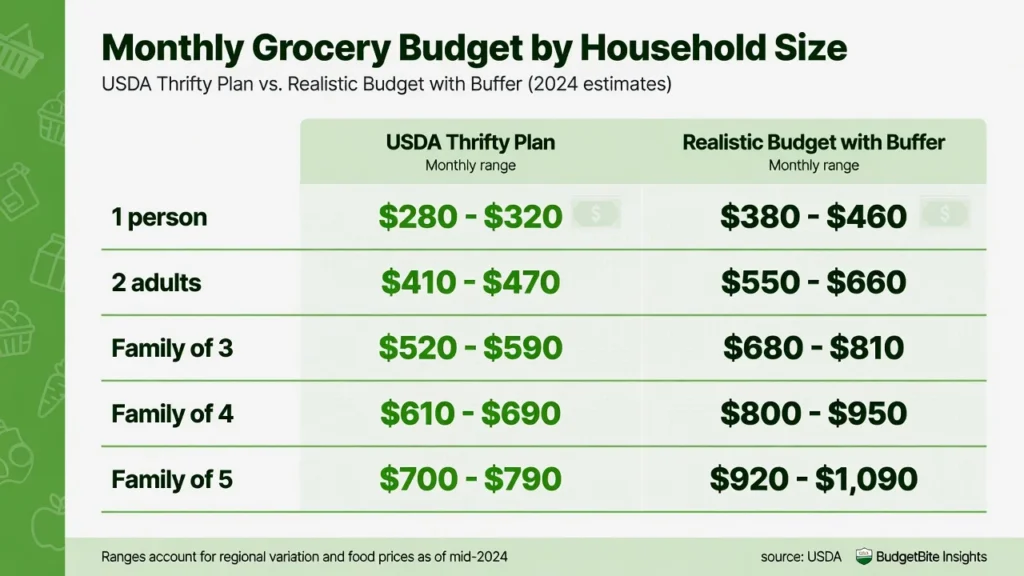
for your actual spending habits.
These are initial ranges, but not rules. The cost of your actual food will be different depending on diet, location and the amount of cooking you do at home. The idea is to take a sensible anchor figure, and adjust it to your actual grocery bill during the first few weeks.
How to create a grocery budget that will not run dry in week two
The structural solution to a crashing grocery budget is not as difficult as many would expect: do not treat it as a single, big number each month and divide it into smaller, weekly groups instead.
This very approach is taught in YNAB (You Need a Budget), a budgeting application with more than a million active users. You do not have a single category named Groceries covering the entire month, but rather create separate categories each week, and structure them around how you actually shop:
Week 1, Week 2, Week 3, and Week 4
The Week 2 is financed at $115 this is the total amount of grocery budget in Week 2 and nothing more. You cannot take a loan in Week 3 without deliberately decide to take a loan. The whole point is that friction is the point. Divide Your Monthly Budget into a Weekly Grocery Budget.
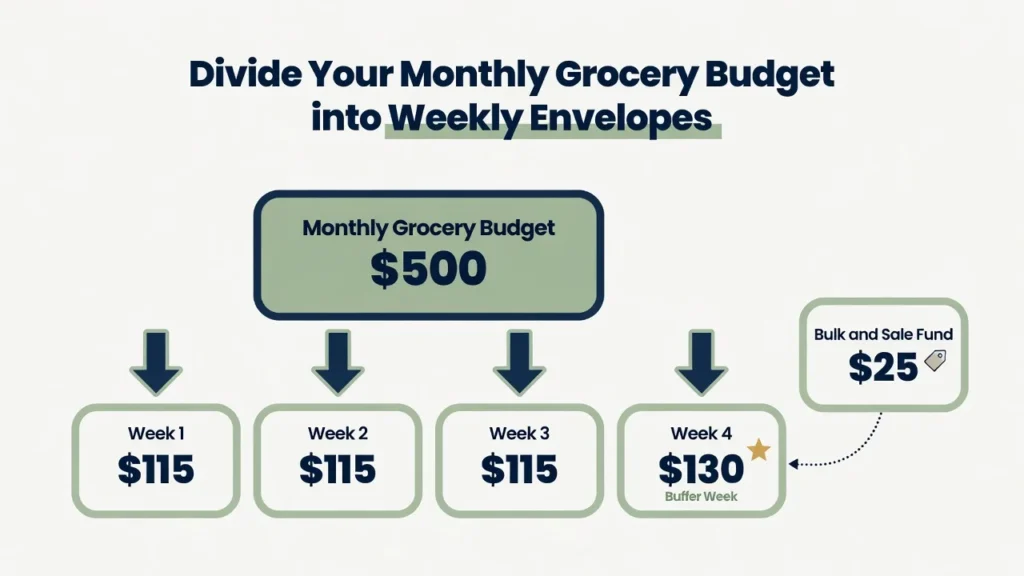
most effective structural fix for overspending.
The math is simple
Split up your monthly budget into four weekly budgets. That would be roughly 115 per week of four weeks on a 500 budget or about 40 left over to fund a Week 5 buffer or your Bulk and Sale category. Give each dollar a job by the end of the month.
The week 4 should be allocated a little bit more than the rest, because week four is when unexpected needs are likely to accumulate – a birthday dinner, a last-minute work lunch, or a pantry item that ran out sooner than expected.
Also there is the smart second category worth establishing with a separate amount of $20 to $30 which sits in isolation of your weekly amounts. When a pantry item is on sale in any capacity, this fund allows you to stock up without cannibalizing your weekly grocery budget.
The reason behind organizing the categories based on time period, i.e. Week 1, Week 2, Week 3, Week 4, is due to the fact that it is a way of shopping that is actually close to the reality of shopping:
one trip at a time, once a week. Patterns can also be spotted more easily due to this budget breakdown.
You will find it, should Week 1 always run over. In case Week 3 is consistently under, then you know where you have a buffer.
Would You Trial the Cash Envelope Method?
The cash envelope system is a step further of the weekly breakdown.
Every week, you actually walk in and pull out in cash, your grocery allocation, wrap it in an envelope, and come to the store with that envelope only. When the money is lost the shopping is complete. In case it seems too old-fashioned to carry cash, digital envelope apps such as Good budget or Every Dollar mimic the same effect.
You put money in a virtual envelope named “Groceries” that you deposit weekly and spend out of that envelope. The limitation is the same. The responsibility is the same. The curb side pickup or online ordering of groceries is a limitation of the cash envelope approach. To such shoppers, it is more feasible to use a digital tracking method.
The Dinner Planning Technique That Can In fact Keep You on Budget
Meal planning works. The issue is that most individuals prepare meals in the reverse way, that is, they begin with what they feel like eating and just hope that when the expenses of all meals are added together, the total will be less than the budget. It practically never does.
The first time I saw it do it correctly was by watching a personal finance creator by the name Alaina go about planning her week. Her monthly food budget is $600, which is divided into 150 per week. She writes at the very top of her planning sheet: $150. That number remains in sight all the time. It is like a little thing. It changes everything. The majority of people do the reverse, they write what they want to make, cross their fingers at the cashier.
Switching that order, budget first, meals second is to have always been planning within your real constraints, not hoping that you will end up inside them. This is constraint based planning and it always leads to reduced grocery bills compared to any other method. Begin With Your Number, Not With Your Grocery List. Enter your weekly budget amount at the top of your meal plan sheet. Make it visible.
Then put a question to yourself, with this number, what am I really able to cook and enjoy this week?
This sounds counterintuitive and that is precisely why it works. Once you begin with the number, the budget ceases to be something you look after the damage is done.
It becomes that which molds the choice that you make. The majority of the people write a list of grocery shopping, based on what they desire, then visit the store and determine the cost. That is all changed with the budget flips. You are not wishing that the money will suffice the meals you ordered. You are making meals based on the cash you possess.
How to Plan Meals Around Sales (Reverse Meal Planning)
The concept of reverse meal planning brings the old method in an inverted manner. Rather than going to a store and picking recipes and then go out to shop those specific items, you go to the store and check the weekly store ad and base your meals on what has already been discounted.
Suppose that this week chicken is on sale, then your meal plan might be as follows: chicken stir-fry on Monday, chicken tacos on Wednesday, and chicken soup using the remaining pieces by Thursday.
Weekly meal planning based around a single protein at a lower price cuts both your food costs and your time in the kitchen, as you are preparing different versions of the same base ingredient across multiple meals.
Allowing the weekly sale to be the basis of your meal plan will nearly always cost less than selecting recipes and then shopping those recipes. You are not fighting the store but working with what the store is already discounting.
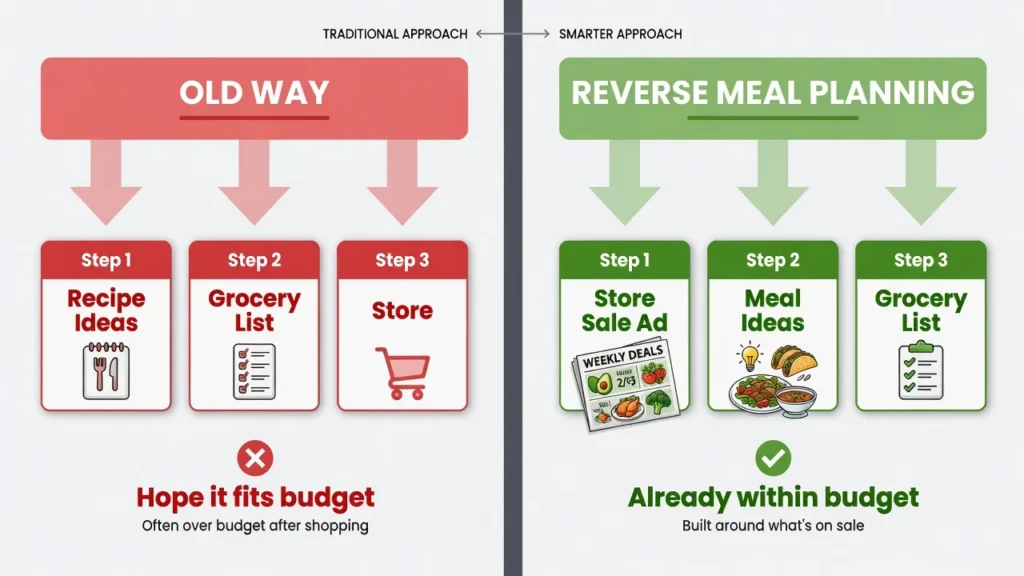
sounds good tonight.
Your Backup Plan of a Budget:
Budget List of The Cheap and Favorite Meals. A short list of meals that are not only cheap, but that people enjoy eating should be provided in every household. This is not a deprivation list. It is a first resort list to which you turn when the budget is tight or when the week has gone sideways.
Think: lentil soup, rice and beans, pasta with marinara, egg scrambles, oatmeal. Frugal recipes that your family will consume without any objection. The price per meal on this list should preferably be less than 2 or 3 dollars per person. When you have the list you will find yourself reaching it more frequently than you thought you would, and that is no bad thing.
The Real Family Shopping Habits That Save Hundreds a Month
My shopping experience that transformed my thoughts on shopping at the grocery store all came at the hands of a woman, who is known as Julie and runs a frugal living community online.
They and her husband spend about 66 dollars a month on groceries that feed two people a month, albeit on the low-skilled positions she has held in the past.
The mechanism underlying such a number can be reproduced, even when the actual total is exceptionally small and if tight finances are driving your need for a tighter grocery budget, there are broader strategies that can help you save money on a low income beyond the grocery aisle as well.
Price Anchor System: Know Your Good Price of 10 Items
Select the 10 items that you purchase the most. To most households this covers milk, eggs, rice, butter, chicken, coffee, canned tomatoes, pasta, bread and oats. Record the minimum price you have ever paid during the last month or two, as regards to each item.
That will be your price anchor. Record it in a note taking app or a little notebook that you carry with you. This system is checking price per unit on shelf tags as opposed to package price. The smaller package with the lower sticker price can often be more expensive per ounce compared to the larger one.
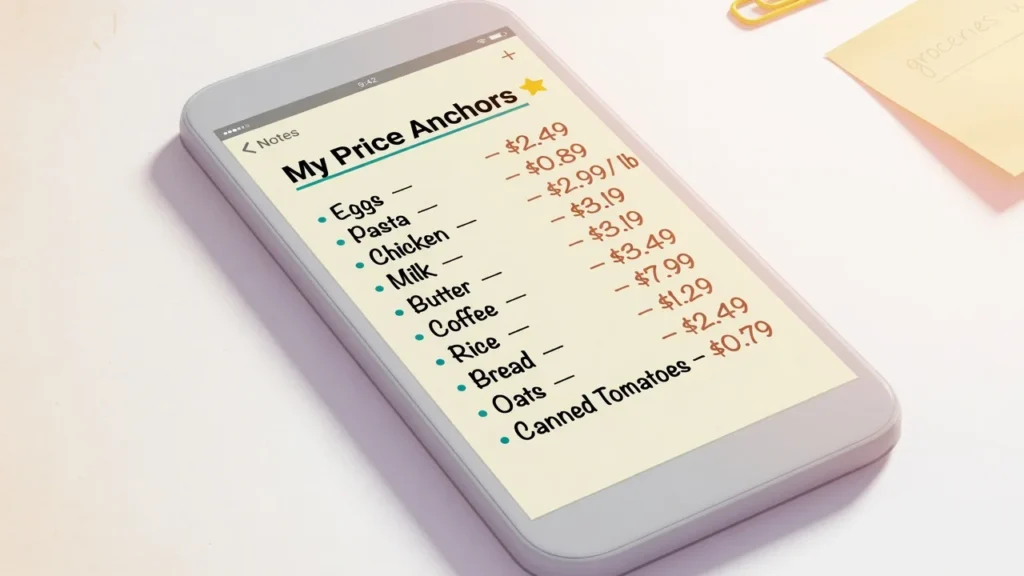
seconds to check at the store.
After getting a price anchor on your most purchased goods, counterfeit sales no longer apply to you. You are aware of the actual price. You are not impressed when a store tells you that chicken is on sale at $4.99 a pound and you know that you purchased the same package three weeks ago at $2.99 per pound. You know to wait.
This type of informed shopping will help you save money on groceries, without you having to alter your diet.
When Stores Mark Down Meat, Bakery and Produce
The majority of grocery stores have a particular time period of reducing the prices of their perishable products. Meat gets reduced. Bakery products are cut in half. Produce receives clearance stickers. Majority of the shoppers do not even suspect that this schedule exists.
Julie was able to find out the markdown schedule of her local store just by asking the salespersons. After learning that meat generally was cut down on Tuesdays and Thursdays mornings, she would arrange her shopping trips accordingly. Ask a manager or a stock employee in your local store when they mark down meat, bakery and produce. It lasts half a minute. The savings are regular.
Why Curbside Pickup Could Be Your Ultimate Budgeting Tool
The curbside pickup offered by grocery stores is not a convenience service. It is a budget control instrument–and one of the most effective instruments of the kind that are available.
When you go online to shop using a grocery application and choose pickup, you can see the balance of your wallet update in real time as you add items. When you spend more money than your weekly budget, you take away something and leave before you check out.
No impulse aisle to wander about, no end-cap display designed to attract your attention, no snack area between you and the exit. The app of your store also opens the door to coupon apps and loyalty rewards that adds to your already budgeted finances.
Cashback applications such as Ibotta are an extra layer to purchases you were already making -savings you receive without modifying what you purchase. Assuming your family is going through large amounts of staples, a membership in a wholesale club at Costco or Sams Club can be paid off in a few months with pantry basics alone.
Budget Dinners First, Work Backwards
Most households find dinners to be the most expensive meal of the day as well as the most difficult to improvise on at the last minute when you are tired and hungry. So plan them first. Before purchasing any other item, allocate the majority of your weekly grocery budget to dinner items.
Lunch and breakfast are less expensive and can be improvised with pantry items, leftovers, and other simple ingredients. This helps avoid a frustrating and common trap: to spend freely on drinks, snacks, and lunch items early in the week, then finding out that there is practically nothing left in the weekly budget to buy groceries at the time one actually needs to obtain the actual dinner ingredients.
Don’t Waste Money: The Food Waste Crisis Most Households Have
The USDA and EPA estimates indicate that about 30 to 40 percent of the food that is purchased in the United States is wasted. That, potentially, is $180 or $240 wasted in a month, not out of ill intent, but out of ill systems.
It is not the fact that people purchase the wrong things that constitute the largest money leak in most grocery budgets. It is because they purchase the right things and discard them. A reduction of food waste is superior to coupons and brand switching every time.
The Eat Soon Bin and Why It Changes Everything
Eat Soon bin is free and can be installed in thirty seconds. It also happens to be one of the best food waste fixes that I have ever discovered.
Name one shelf or one bin in your refrigerator the Eat Soon zone. Whatever must be utilized in the next couple to three days, goes there. Spinach that has wilted is put into the bin. The can of beans that is open slides there.
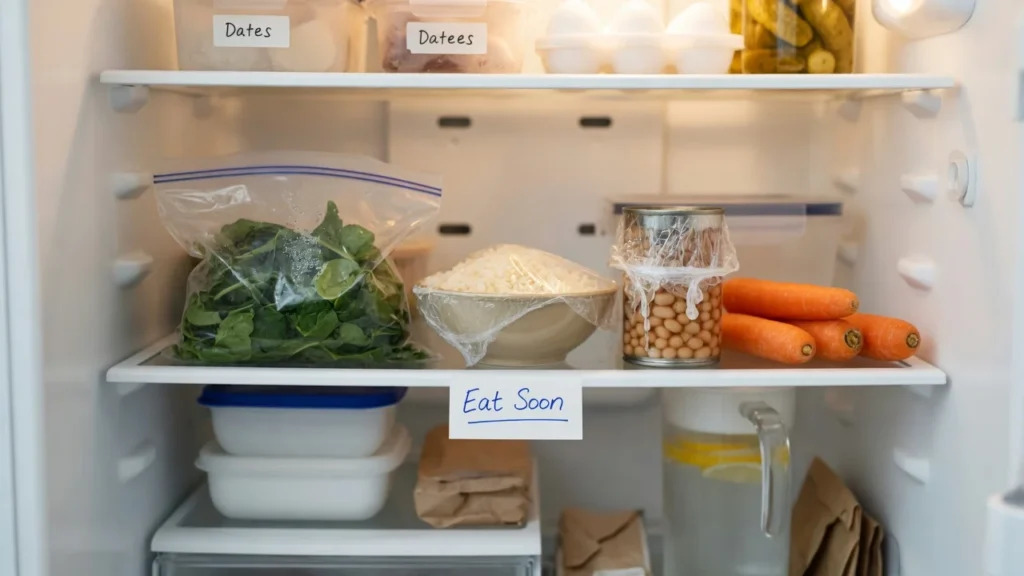
plan and shopping trip.
There the three carrots of the last week recipe go
The idea is pretty straightforward: you never plan any meal or write any grocery list without checking the Eat Soon bin first. Leftovers cease to be buried and forgotten. You use what you already have rather than purchasing copies of things that you already possess.
The Once-a-Month Pantry Cleanout Weekend that Saves $40 to 80
Avoid going grocery shopping once a month. Use that weekend to cook with what you already have in your fridge, freezer and pantry.
There is food in most homes that they are unaware of sitting in the back of their shelves. A pantry cleanout weekend transforms that long-lost inventory into actual meals and saves a trip to the shopping mall.
By simply not making a single shopping trip every month by using what is already in the pantry cabinet, the average household will save between 40 and 80 dollars every month. In one year, i.e. 480 to 960, in the amount of recovered food budget without altering the manner or content of your shopping.
Food Storage Slip-ups That are Silently Costing You Money
Some of these storage practices are directly related to food spoiling at a rate that is not supposed to happen, and most individuals are ignorant about them.
I was unaware of the mistake with potatoes and onions until the third month of my attempts to make groceries last longer. I was discarding sprouted potatoes on a frequent basis and I did not know why.
One of the most frequent errors when it comes to storing food in home kitchens is the storage of potatoes and onions simultaneously. Onions produce a gas which speeds sprouting of potatoes. They should be kept in different cool and dark places and both will last much longer.
Carrots that are kept loose in the fridge dry up easily. Put them in a closed container with cold water and they remain crisp many weeks as opposed to days.
The majority of fridges have humidity-adjustable compartments one of high humidity and one of low humidity.
The high-humidity drawer takes in leafy greens and herbs
Fruits and vegetables which produce ethylene gas, such as apples, are placed in the low-humidity drawer. Proper use of these drawers can prolong the life of fresh vegetables between one or two days up to over a week depending on the item.
The last five-second habit is to take a quick photo of your fridge and pantry before you go to the store. This helps avoid double-buy, one of the less noticeable ways that households add to their grocery bill without realizing it.
How to plan Groceries at Weeks End Without Running out
It is essential to know your monthly figure. Its implementation on a weekly basis is where the system comes in handy.
The first question I ask myself at the beginning of each week is: What can I make with what I already have? The first things to check in planning the entire week is to check the Eat Soon bin and the pantry before anything is added to the shopping list.
The Two-Store Strategy
Two-store strategy is effective when alternatives are available around. Use one store to shop pantry staples where prices are always low, and a second stop another grocery store, a discount grocer like Aldi or a local farmer market to get a weekly meat or seasonal produce deal. This division of the list will save about 20 dollars a trip, in cost of purchasing all of that in one place.
Particularly worth considering is the market of the farmer in case of seasonal products. Local fruits and vegetables are cheaper, tastier, and sometimes fresher than out-of-season fruits and vegetables shipped over the state.
How to Shop at the Grocery Store on a Budget without White-Knuckling It
Majority of the budgeting recommendations assume that grocery shopping is a strictly rational process. It is not. Grocery stores are also designed environments that are geared towards creating unintended expenditures – and knowing how they do it is half the battle.
The Store Brand Switch That Saves $10 to 20 Every Trip
The vast majority of the population is reluctant to change to generic brands overnight. It is like making a huge, awkward transition. The more intelligent interval would be to swap once in every trip.
This week purchase an item you usually purchase by name in the store-brand version of that item. A good place to start is with canned tomatoes – the difference is almost indistinguishable. The following week, use store-brand pasta or store-brand oats. With just a few little switches, it will save the individual at least ten to twenty dollars in savings per trip over a period of more than a month.
Many of the store-brand items are also manufactured in the same plants by the same large manufacturers as the name brands. Land O’Lakes sells some store-branded butter. Dannon produces store-brand yogurt on a number of large retailers. These are not secrets, but are extensively covered in food industry reporting, and validated by supply chain research.
The Killing of a Good Grocery Budget by Impulse Buying
There is a price to everything in your cart that was not planned. Not only on the financial front but to a structural level as well. It is through impulse buying that the well-planned grocery budgets silently crumble.
Three strategies that are effective: shop before you eat (hunger makes everything look good to buy), shop with a written list and treat items not on your list as something not to buy at all, and use curbside pickup to eliminate the in-store experience altogether.
A last point: have one planned treat. Choose a small dollar amount, say about 5 dollars, and select one thing which is fun, and falls within that small dollar limit. This is no cheat, this is a real strategy. It eradicates the no-more-no-less psychology that renders hard and fast budgets ineffective.
How to Have a Healthy Grocery Budget and Not Reduce the Nutritional Quality
A common myth that has remained throughout the history of grocery budgets is that healthy eats are costly. This is usually the case in my experience.
My grocery bill reduced most visibly as I ceased to purchase what I considered to be, the health food and I began to purchase actual whole food. Eggs, oats, lentils, frozen spinach. The store-brand equivalents of those four products alone will satisfy most of my protein and vegetable requirements in a week in less than half the price of packaged health foods.
Some of the nutritionally best foods are also the least expensive: eggs, dried beans, lentils, oats, brown rice, frozen vegetables, and in-season foods. These are not the compromise foods. They form the basis of a truly healthy diet.
The cheapest sources of proteins that, in fact, keep you full
Protein is generally the most costly item in any grocery trip – but it need not be so.
Eggs are difficult to crack. Even high quality pasture-raised eggs cost about $0.50 per egg, and a two-egg meal costs one of the least expensive protein sources anywhere.
Even traditional eggs are cheaper.
Lentils are cheaper per gram of protein than just about any other food you can purchase. A one pound bag of dried lentils costs about 1.50 and has eight or more servings. They do not need any soaking, they cook within less than 30 minutes and they take up any flavor that you cook them with.
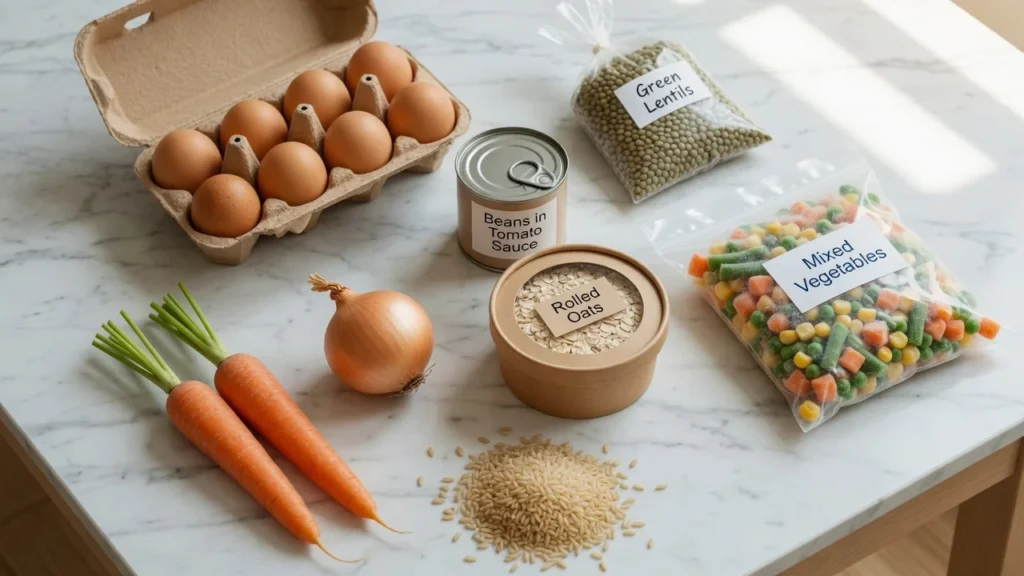
nutritious — eggs, lentils, oats, and frozen vegetables included.
The list of budget protein is completed with canned beans, canned fish, and whole chicken thighs. Each is a versatile, ubiquitous, and much less costly per serving than any protein bar or packaged convenience meal.
A mention should be made of frozen vegetables. They are harvested when they are at the optimal level of freshness and they are frozen immediately, a factor that helps to maintain the nutrition of the food items. They are in fact usually healthier than fresh produce that has been in transit a few days. And they get rid of the waste problem altogether – use just what you need and put the rest back into the freezer.
The New Way to Keep Track of Your Spending on Groceries in a Way that It Will in fact tell you something
Majority of the articles will mention, “track your spending and move on. Tracking however is only useful when it produces information that you can take action upon.
Measure weekly, not monthly. A monthly total informs you of how a month has ended. A weekly total informs you of what is going on in time to alter it.
The best thing that tracking can tell you is your own “budget drainers.” They are such things, which appear small, but silently swell the size of your grocery bill each week. A high end sparkling water culture.
Cheese that is specialty and only used in a single recipe. Ready-made vegetable meals that are thrice the entire amount. When you are able to name your budget killers, you will be able to determine which ones are worth retaining and which ones you would rather trim.
Monitoring your spending on groceries is not about catching yourself up to no good. It is concerning accumulation of sufficient data to know where your money is actually taking (and then making a single change at a time).
The 10 Best Apps to Track Your Groceries Budget
In the case of budget tracking applications, YNAB (You Need a Budget) has the best potential in implementing the weekly sub-category system that will be discussed in this article. It is constructed around the idea of putting each dollar to work before you can spend it, which is directly comparable to the method of the weekly category described above.
To track groceries more specifically, one may use apps such as Grocery Pal or even a simple Notes app with weekly totals to track the groceries but eat lighter. Zero-effort starting point: bank and credit card apps which automatically sort transactions are a zero-effort starting point in case you do not want to enter receipts manually.
The most basic system that can be conceived: take the picture of each grocery receipt and place it in a special folder on your phone. Once a week, add up the totals. No app required. No setup. Just data.
When Your Grocery Budget Goes off the Track (and How to Get it Back on Track Fast)
There are months that are not going to be as planned. A family comes and you cook two times as many people. Prices shoot up on necessities that you depend on. A week becomes hectic and you have more takeout than you thought. That is no budget failure. And that is what an actual month is like.
Once the grocery budget loses the track, the initial action plan is to tell what exactly took place.
Was it a single incidence? A structural issue with the setting of the budget? A price explosion on a commodity you are dependent on?
The fix is determined by the answer.
After you have the result of what happened, make a slight reduction in the amount allocated the following week. Assuming that you have overspent by 30, you will need to reduce the next two weeks by 15 each, you will be spreading the correction so as not to cut the next week meals in half to cover this week.
Take out your Cheap and Favorite meals list during the correction weeks. The reason that those meals are here is because they are here at this particular time. They are not a correction.
They are the plan.
Julie, one of the women, has used grocery budget discipline as a fundamental element of a financial plan which enabled her and her husband to pay more than 120,000 in debt in less than five years.
The lever was not restricted to the grocery budget, but it was a steady one and it is consistency that will keep the system working with time. If you are starting from a tight financial position and want to build that broader system, a guide to how to budget money on a low income can help you connect the grocery work you are doing here to the rest of your household finances.
Frequently Asked Questions
To learn how to budget groceries, you must first know what is the realistic target number of your household.
How much should you spend on groceries?
Begin with the USDA Thrifty Plan to your family size – the amounts are revised monthly, and can be found on the USDA site. The build then up to a 10 to 20% buffer over that number. Whatever you may imagine you spend, the actual figure will be nearly always more.
So, how can I stop myself going over my grocery budget on a monthly basis?
The surest solution is to divide your monthly budget into weekly ones and consider each week as a distinct budget. Week 1 overspending can be seen before it destroys the entire month. Combine this with a written shopping list and adhere to it.
Is it always a good way of saving by buying in bulk?
Bulk buying is a saving of money on the right things and a spending of money on the wrong things. Bulk food, such as rice, oats, canned goods, dried beans, etc., is safe to store at room temperature; however, refrigeration or freezing is recommended to prevent spoilage. The perishables that you are going to freeze at once, such as chicken, are also good in bulk. What does not work: things that are hard to find, items with a short shelf life, or those that you make purchases gradually.
How can you meal plan on a budget?
Begin with your number of weekly budget, not your recipe list. Before you consider a single meal, write the number on the top of your planning sheet before you think of a single meal. Next review the weekly store advertisement of what is on sale and base your meal plan around those discounts. Sale first, then recipes Reverse meal planning always results in a lower grocery bill compared to recipe-first planning.
What can I do to decrease food waste in the home?
Install an Eat Soon bin in your refrigerator – a special shelf with things to use within two to three days. Check it prior to all meal plans and all shopping trips. After a month, you should not go out to do shopping at all, you can cook only with the available materials. These two habits will alone eradicate the majority of food wastes in the homes.
Will I be able to eat healthily, with a tight grocery budget?
Yes–and the most inexpensive whole foods tend to be the most nutritious. Inexpensive, high in nutrients and versatile are eggs, lentils, oats, canned beans, brown rice, frozen vegetables and seasonal produce. A diet constructed of these foods is less expensive than one constructed of packaged convenience foods.
So, what to do when food expiration dates are over?
The majority of date labels on packaged food refer to optimum quality, rather than safety. The labels of best by, sell by, and use by are manufacturer quality estimates – very little food will become unsafe the moment the date is passed. But be careful with meat and dairy – those are the food items in which storage conditions are most critical, and in which food spoilage can be accelerated compared to other packaged goods. Follow your nose: you ought not to eat something that stinks or looks unpleasant.
What can I do when I have never previously monitored any grocery expenditure?
The initial step is to take a photo of all grocery receipts in the next two weeks. Sum up the total at the end of the second week. That amount, the actual amount, not the approximated amount, is your point of departure. You can base your budget on what you really spend then work out what and where you can cut back on that.
Final Thoughts
The problem of learning how to budget groceries does not deal with being perfect or as little as possible. It is of constructing a plain, straight forward system that suits your real life and your real house hold.
Begin with a realistic figure. Divide it into weekly. Planning meals should not be based on the budget but vice versa. Cut down waste in advance of cutting down on expenditure. Keep track of them every week in order to observe the trends.
Deprivation is not needed in any of these steps. They require structure. And form, when you have it, is labour, which will never be labour.